
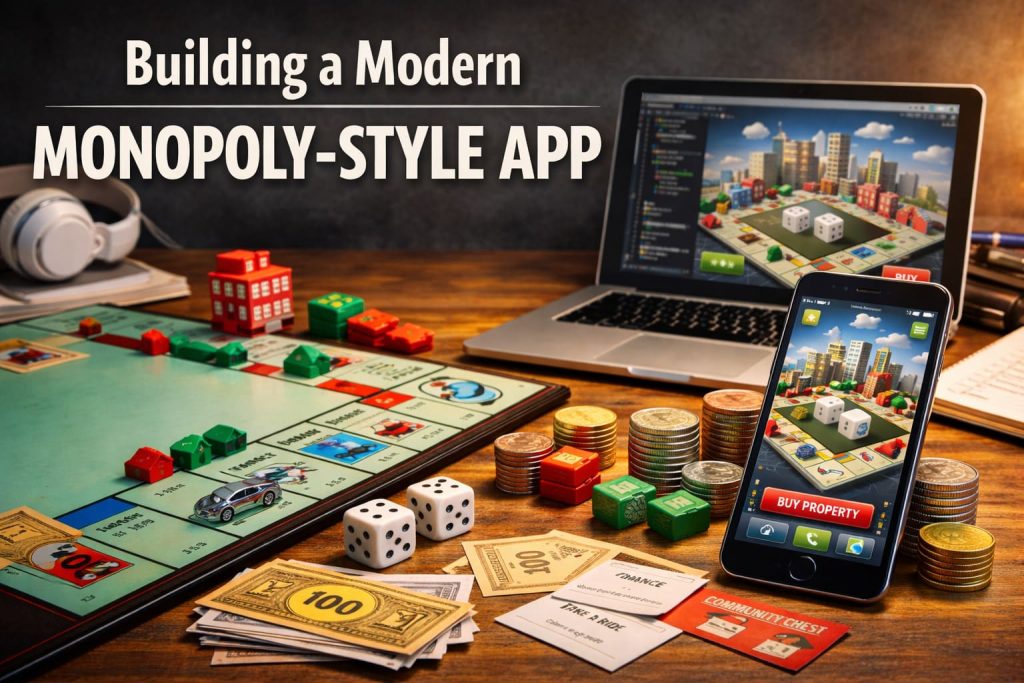
Picture a small team of developers sitting around a laptop, sliding a Figma board across the screen, excited about hexagonal tiles and animated dice. Six weeks later, the board looks great. The dice roll with a satisfying thud. And then someone asks: what happens when two players are on different continents and one of them buys a property at the exact moment the other lands on it? The conversation gets quiet.
That awkward silence is where the real work begins. Drawing a board is genuinely the easy part of building a Monopoly-style game. The hard part is everything underneath: keeping game state consistent across devices, enforcing rules that feel fair, syncing turns without lag, and making sure the experience doesn’t fall apart when a player’s phone loses signal for ten seconds. These are engineering and design problems that don’t show up in a Figma file.
Players have high expectations for this genre. Communities form quickly around board-style games, and users will share screenshots, compare notes, and post about monopoly big baller results when they feel the system rewarded or cheated them — and that perception matters more than any leaderboard number. Getting the underlying architecture right is what separates an app that earns repeat sessions from one that gets uninstalled after a bad game.
This guide covers architecture, game loop design, and cross-platform strategy in practical terms. It’s not about UI mockups or marketing. It’s about the decisions that affect how your app actually runs once real users are in the same game room together.
Expect trade-offs, not a single “correct” answer. Different team sizes, budgets, and target audiences push toward different solutions. The goal here is to give you a map of the territory so you can make informed calls early, before technical debt accumulates around the choices you didn’t realize you were making.
Start With the Core Game Loop

Before any code is written, it helps to write out the moment-to-moment loop in plain language. In a Monopoly-style game, that loop usually looks like this: a player takes a turn, performs an action (roll, draw, move), the game calculates consequences (land on a space, trigger an event, collect rent), the player makes a decision (buy, auction, trade), and control passes to the next player. That’s it. Everything else — card systems, power-ups, seasonal events — plugs into that skeleton.
Pacing matters more than feature count. A loop that resolves quickly and gives each player a meaningful decision every few minutes will retain players far better than a feature-heavy loop that drags. Turn timers, idle enforcement, and async fallbacks all serve pacing. If someone sits idle for two minutes every round, the other three players quit — not because the game is bad, but because waiting is boring.
- What is the maximum number of players per game?
- How long should a typical session last?
- What triggers the end of a turn?
- What happens when a player goes bankrupt or disconnects?
- Can players perform actions out of turn (auctions, trades)?
- How are ties or edge cases resolved — automatically or by vote?
- What is the win condition, and can it be detected server-side reliably?
- Does the game support spectators or observers?
- How does the game handle async play (one turn per day) vs. live play?
- Are there AI bots to fill empty slots, and how do they affect game balance?
Game Rules Before Code
One of the most common mistakes on board game projects is jumping into implementation before formalizing the rules. Every ambiguity in the rules document becomes a potential bug later. If the rules say “players may trade properties before their turn ends” but don’t specify whether a trade can be initiated by either player or only the active player, you’ll eventually get a conflict in production that’s hard to patch cleanly.
Write the rules as a specification — with explicit turn order, edge case handling, and win condition logic. Use numbered steps. Rule ambiguity is a bug source, not a design flexibility. You want your ruleset to be deterministic enough that a developer can implement it without interpretation. Then test the rules with humans on paper before writing a single line of game logic. Paper prototyping catches pacing and fairness issues faster than code reviews do.
Special events, cards, and random modifiers deserve their own specification section. Each card effect should be listed with its exact trigger, its exact outcome, and how it interacts with contested states like bankruptcy or mid-trade scenarios. This document becomes your QA reference as the app grows.
Choosing the Architecture
The biggest early decision is whether game logic lives on the client or the server. Client-authoritative architecture means each player’s device runs the game logic and results are reported to a server. It’s faster and cheaper to build, but it opens the door to cheating and sync conflicts. Server-authoritative means the server runs all game logic and clients are essentially display layers — more expensive and complex, but far more trustworthy for competitive play.
For most Monopoly-style games, a lightweight server-authoritative model with a turn-based sync strategy is the sweet spot. Real-time sync (like in a shooter) isn’t necessary when turns happen every few seconds at minimum. A request-response model per action keeps things manageable without requiring persistent WebSocket connections for every move.
| Architecture | Best For | Main Advantage | Main Risk |
|---|---|---|---|
| Client-authoritative | Solo or trusted-friend play | Low server cost, easy to prototype | Cheating, desync between players |
| Server-authoritative | Public multiplayer, competitive modes | Single source of truth, cheat-resistant | Higher infrastructure cost, more latency |
| Hybrid (server validates, client predicts) | Mid-scale apps with live multiplayer | Good UX speed with server safety | Rollback/reconciliation complexity |
State Management and Sync
Game state in a board app has at least three distinct layers: board state (who owns what, which spaces are developed), player state (position, balance, held cards, status), and economy state (total currency in circulation, auction history, trade logs). Each layer needs its own update frequency and conflict resolution strategy. Board state changes rarely and must be agreed on by all clients. Player state changes on every turn. Economy state feeds analytics and balance tuning.
Reconnection handling is where many apps fail silently. If a player drops mid-turn, the server should hold the game state exactly as it was and allow that player to rejoin within a timeout window. On rejoin, the client requests a full state snapshot rather than trying to patch from the last known event. Always send full state on reconnect, never a diff — diffs compound errors when packets are missed.
Consider what happens concretely: Player A rolls and the dice show seven. Before the server confirms the move, Player A’s phone drops off WiFi. If the client already animated the move, the player expects to be on that space. If the server never confirmed it, the true position is still the old one. On reconnect, the server state wins — the client resets. This is disorienting but correct. Good UI cushions it with a “reconnecting” state and a smooth position correction animation rather than a jarring jump.
Designing a Fair and Fun Economy
A Monopoly-style economy has currency sources (passing go, collecting rent, winning events) and currency sinks (buying properties, paying rent, card penalties). The balance between them determines how long games feel and whether players experience comeback moments or crushing inevitability. Inflation happens when sources outpace sinks — everyone has so much money that the economy feels meaningless. Deflation happens when sinks dominate and early leaders compound their advantage unchecked.
Comeback mechanics are worth designing explicitly. Random events, catch-up bonuses tied to player position, or dynamic pricing on late-game purchases can prevent a runaway leader from making the last twenty minutes feel predetermined. These mechanics have to be subtle enough that skilled play still matters, but present enough that losing players don’t quit early.
- Starting everyone with the same balance but different board position advantages
- Letting currency inflate without any sinks, making properties feel cheap late-game
- Creating rent values that scale too aggressively, ending games in three turns
- Ignoring trade fairness — no system to flag obviously lopsided trades
- Randomizing catch-up mechanics so heavily that skilled play feels irrelevant
- Forgetting to cap maximum rent, creating inescapable debt spirals
- Tying premium currency to game outcomes in ways that feel pay-to-win
- Making bankruptcy instant with no negotiation window
- Removing all randomness in favor of pure strategy, losing the party-game feel
Multiplayer, Matchmaking, and Social Layer
Friend games and public matchmaking need separate lobby flows. Friend games require invite links, shareable room codes, and a waiting room where the host controls the start. Public matchmaking needs skill or session-length bracketing — pairing a first-time player with someone who has five hundred games is bad for both of them. Async turn support, where a player has hours rather than seconds to take a turn, dramatically expands your potential audience and suits mobile use patterns.
Chat in multiplayer board games is mostly emote-based in production-quality apps. Free-text chat requires active moderation and exposes the app to user safety obligations that are expensive to fulfill. Push notification design matters here too: players need timely nudges when it’s their turn without being spammed into disabling notifications entirely. One notification per turn event, no marketing content mixed in.
Cross-Platform Strategy From Day One
Waiting until after launch to think about cross-platform support is a common and painful mistake. The shared layer — game logic, state management, API communication — should be platform-agnostic from the start. UI rendering, input handling, and platform-specific permission flows are the parts that diverge. A shared game logic library compiled for iOS, Android, and web will save months of work and prevent the logic drift that comes from maintaining separate codebases.
Input differences matter more than screen size. Touch input on mobile needs larger tap targets and swipe-based actions. Desktop users expect hover states and keyboard shortcuts. Web users expect URL-shareable game states. Account linking across platforms — signing in on mobile, picking up the same game on a browser — needs to be designed into the auth layer early, not retrofitted.
| Layer | Shared Across Platforms | Platform-Specific Considerations |
|---|---|---|
| Game Logic | Rules, state machine, economy calculations | None — keep it pure and portable |
| UI Layer | Component library, design tokens, theme system | Layout breakpoints, input model, safe areas (iOS notch) |
| Networking | API contracts, state sync protocol | Background fetch limits (iOS), app lifecycle handling |
| Monetization | Purchase logic, entitlement checks | StoreKit (iOS), Google Play Billing, web payment APIs |
| Auth & Accounts | Token management, session storage | Sign in with Apple (required on iOS), Google Sign-In |
Content Pipeline and Live Ops
A board game app that ships one set of boards and never changes will plateau in retention within weeks. Live operations — events, themes, seasonal boards, limited cosmetics — are what keep players returning. This doesn’t mean a giant content team. It means building your content pipeline to support rapid changes without a new app release for every update.
Remote config is the foundation. Board layouts, event triggers, pricing, and feature flags should all be configurable server-side. That way a seasonal Halloween board can go live on October 1st without an app store update cycle. The same infrastructure lets you run limited-time events and roll them back if something breaks.
- Remote config system for game parameters
- CMS or lightweight admin panel for event scheduling
- Asset bundle system (lazy-load boards and themes)
- Seasonal event framework with start/end date logic
- Cosmetic skin system (boards, tokens, dice)
- Push notification templates for event announcements
- Feature flag service for gradual rollouts
- Player inbox for in-game messages and gifts
- Leaderboard reset tooling tied to season endings
- Audit log for live-ops changes (who changed what and when)
Analytics, QA, and Release Discipline
You can’t balance a game economy you can’t measure. Event tracking should cover every meaningful player action: turn completion, property purchase, trade initiation, session length, and session-end trigger. Funnel analysis on game completion rates — what percentage of games started are actually finished — tells you more about pacing and UX friction than any survey will.
Crash reporting and session replay for UI flows are table stakes. Balance checks require economic simulation: run thousands of simulated games against your rule set to see how currency distribution looks at game end. A/B testing on game parameters (starting balance, turn timer length) should be ethical and product-focused — testing to improve player experience, not to maximize purchases.
The Google Play launch checklist is worth reviewing before any major release, not just for compliance but as a QA prompt — it surfaces platform-specific edge cases that internal QA teams often miss.
| Metric | What It Reveals | Common False Conclusion |
|---|---|---|
| Game completion rate | Pacing and frustration points | “Low completion = boring game” (often it’s a technical drop-off) |
| Average session length | Whether turn loops feel too long or short | “Longer sessions = more engaged” (can mean confused or stuck) |
| Day 7 retention | Habit formation and onboarding quality | “Low D7 = bad game” (often it’s notification strategy failing) |
| Trade frequency | Social layer engagement | “No trades = players don’t want it” (may be UX discovery issue) |
Monetization Without Killing Trust
Cosmetic purchases — alternate board skins, token designs, animated dice — are the cleanest monetization model for this genre. They generate revenue without affecting game balance, which means every player is on a fair playing field regardless of spend. A battle-pass-style seasonal track that offers cosmetics and quality-of-life features (like game history or stats) at a fixed price gives spenders a clear value proposition without pressuring non-spenders.
Optional rewarded ads, where a player can choose to watch a short ad for a small in-game benefit, are acceptable if they’re genuinely optional and rate-limited. What erodes trust fast is ads that interrupt gameplay, or purchase prompts that appear at emotionally charged moments (just after a bankruptcy, for example). Clarity and timing are everything.
- Never lock core gameplay behind a paywall
- Never show purchase prompts during active turns or loss moments
- Disclose odds clearly if any randomized purchase is involved
- Make it easy to see exactly what a purchase includes before buying
- Honor all purchases immediately without delays or conditions
- Avoid time-pressure countdowns on non-expiring offers
- Keep free and paid cosmetics visually comparable in quality
- Provide a restore purchases option on all platforms
Pulling It Together
A Monopoly-style app succeeds or fails on systems that players never consciously see. Reliable state sync, a consistent game loop, fair economy design, and a stable cross-platform experience are what separate a game people return to from one they forget about after a single session. The board is the easy part — the rest is engineering discipline and thoughtful design.
Building original takes on the board game format — new themes, inventive rules, fresh progression mechanics — is where the creative opportunity lives. The genre is proven. The audience exists. What’s needed is execution that respects players’ time and intelligence, stays honest about what costs money, and works reliably across whatever device someone picks up.
The best board game apps feel effortless to play precisely because the team worked hard on everything the player never notices.